
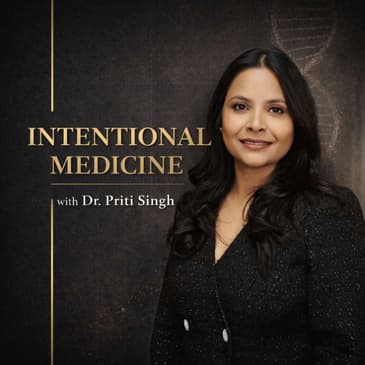
In this episode of Intentional Medicine, host and longevity specialist Dr. Priti Singh unravels the real role of AI in wellness and longevity care. As artificial intelligence becomes increasingly entrenched in health conversations, Dr. Priti Singh moves beyond the hype to ask: where does AI genuinely improve patient outcomes, and where does the irreplaceable judgment of a physician come in? Together, they explore how AI amplifies medical decision-making, the importance of clinical judgment amid a flood of data, and the risks and rewards of emerging direct-to-consumer AI health platforms. Whether you’re a practitioner, patient, or just curious about the cutting edge of medicine, this conversation offers both hope and clarity for navigating the intersection of technology and true patient care.
00:00 AI's role in longevity medicine
05:28 AI as a research assistant
08:06 Balancing innovation and patient care
14:01 Discussing presentgevity and living fully
15:13 Balancing health and presence
19:08 AI and longevity in medicine
How AI Is Shaping the Future of Longevity Medicine: Insights from Dr. Priti Singh
Artificial Intelligence (AI) is revolutionizing nearly every field, and medicine is no exception. In the latest episode of “Intentional Medicine” Dr. Priti Singh dives into where AI genuinely adds value to wellness and longevity care and just as crucially, where human physicians remain irreplaceable.
AI as an Intelligence Amplifier, Not a Replacement
Dr. Priti Singh makes it clear from the outset: AI in medicine is not about replacement, it's about amplification. The complexity of longevity medicine means practitioners are inundated with data, traditional labs, genetic data, metabolic markers, wearable device outputs, and more. The sheer volume can overwhelm even the most organized physician.
Here, AI becomes an “intelligence amplifier,” enabling practitioners to quickly connect disparate data points and recognize patterns that might otherwise go unnoticed. It helps organize, recognize, and personalize care three core strengths that can dramatically improve both efficiency and precision in patient assessment 03:27.
Where AI Excels: Organize, Recognize, Personalize
Organize: AI handles vast quantities of data, both across and over time, bringing together lab results, histories, and health metrics into a manageable synthesis.
Recognize: It spots patterns in the data trends or anomalies that might not be apparent when reviewing reports one by one.
Personalize: With the patterns identified, it enables much more tailored recommendations to patients, grounded in their unique biological profiles.
For example, a man in his 50s presenting with fatigue and weight gain isn't simply subjected to basic hormone checks. Instead, with AI's assistance, a provider can examine his overall sleep pattern, body composition, metabolic status, stress levels, and more all in a fraction of the time 04:31.
AI as a Tool, Not a Decision Maker
Despite these advantages, Dr. Priti Singh draws a distinct line: "AI can inform a decision. But it should not own the decision" 05:28. AI is akin to a highly efficient research assistant offering up patterns, potential issues, and even suggesting interventions. But translating those patterns into clinical action remains the role of the physician, who considers context, patient preference, and clinical judgment.
This is especially vital in intentional medicine, which emphasizes assessing, optimizing, and sustaining care, an approach enriched, but not dictated, by AI 06:19.
Risks of Over-Reliance on AI
The conversation turns to potential pitfalls. The biggest risk? Confusing information with true understanding. Because AI learns from existing patterns in data, any gaps or biases in that data can lead to incomplete or even flawed recommendations. AI can sound convincingly authoritative but might miss contraindications or misunderstand the nuances of a patient’s unique context 07:09.
Dr. Priti Singh warns that, particularly in longevity medicine with its frenzy of new supplements, peptides, and biomarkers a clinician’s oversight is essential to prevent innovation from devolving into risky experimentation 08:30.
The Irreplaceable Human Touch
Despite advances, there are critical things AI simply cannot replace: the therapeutic relationship and the lived human experience. Dr. Priti Singh introduces the concept of "presentgevity": not just adding years to life, but adding presence to the years you have 14:17. It’s not about optimizing every biomarker at the expense of actually living well. Sometimes a patient’s need is less about numbers and more about feeling energized, sleeping well, or being able to cherish time with loved ones.
Looking to the Future
What excites Dr. Priti Singh about AI is its potential to propel medicine into a proactive era. Rather than waiting for disease to manifest, AI can help chart biological trajectories, enabling preventive interventions that maintain health rather than simply treat illness 19:19.
A Philosophy for AI in Medicine
To sum up: AI should expand what clinicians can see, but never replace the essential responsibility to think, listen, and care. The future isn’t about AI vs. physician, it’s about thoughtful physicians equipped with better tools, personalizing and humanizing medicine even as technology evolves 20:10.
As this episode makes clear, the promise of AI in medicine isn’t just about smarter machines, but smarter, more intentional care for all.
https://eternawellnessmd.com/services/
https://intentionalmedicineshow.com/