
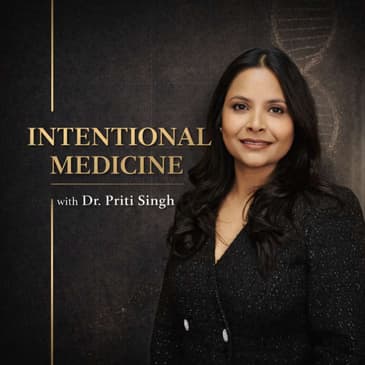
Welcome to another episode of Intentional Medicine with Dr. Singh, where we explore the real meaning of health design in a system built to manage disease. Today, we're diving into a topic that often goes unquestioned in modern healthcare, more testing. From annual lab panels and advanced diagnostics to wearable trackers and direct-to-consumer tests, health data is everywhere. But does more data always translate to better health? Join us as Dr. Priti Singh unpacks the surprising downsides of overtesting, explains why testing should serve a purpose rather than satisfy anxiety, and reveals how intentional diagnostic strategies can transform healthcare from noise to true insight. If you've ever wondered if all that testing is actually helping or possibly harming your health journey, you won’t want to miss this conversation.
00:00 The pitfalls of overtesting
04:05 Importance of clinical context in testing
06:28 Overtesting pitfalls in healthcare
10:04 Understanding test results and interpretation
13:22 Hypervigilance fatigue from health data
18:08 Understanding TSH levels and ranges
21:47 Interpreting lab test results
26:19 Impact of glucose monitoring tools
30:09 Focusing on foundational health habits
33:59 Making informed decisions about testing
35:12 Timing matters in cortisol testing
Rethinking “More Is Better”: Insights from Intentional Medicine
In a world inundated with health data, annual panels, wearable trackers, and direct-to-consumer tests, it’s easy to believe that more information always means better outcomes. But as Dr. Priti Singh explains on the latest episode of Intentional Medicine, this assumption may be misguided and at times, downright counterproductive.
The Myth of More Data
As the conversation started, noting how cultural attitudes equate action (like ordering a test) with progress. But Dr. Priti Singh quickly challenged this mentality, noting that without interpretation, data is simply noise. “We have this mindset that more is better and we assume every test catches something meaningful,” Dr. Priti Singh said at 01:23. But every test also comes with the risk of false positives or incidental findings—results that may not indicate real problems but can still provoke anxiety and trigger further unnecessary procedures.
Testing as a Tool, Not a Solution
So what role should diagnostic testing actually play? Dr. Priti Singh offered a memorable metaphor: tests are like a compass. If you know your destination, the compass is invaluable. But if you’re wandering without direction, it simply spins and confuses. Purpose-driven, targeted testing should be in service of a patient’s unique story and clinical reasoning, not a blanket solution.
“A purpose-driven diagnostic test gives you value only if you start with the clinical story,” Dr. Priti Singh explained at 04:15. It’s the patient’s narrative their symptoms, their history, that should guide what tests are ordered, not a desire to simply “do more” or cast the widest net possible.
When Testing Goes Too Far
The real trouble begins when tests are ordered out of clinician or patient anxiety, not a well–formulated clinical question. Over-testing might deliver a superficial sense of action while diverting attention from foundational health behaviors, like getting enough sleep, eating nutritiously, managing stress, and moving one’s body.
“When you order 200 biomarkers, perhaps you have 10-20 abnormal results, not because something is wrong, but because you’re virtually guaranteed to find something abnormal,” Dr. Priti Singh warned at 06:42. Instead of clarity, this generates 20 new sources of worry and confusion for patients.
The Psychological Toll
Over-testing and over-monitoring can create a powerful anxiety loop. Layla shared her own recent experience with heart testing: “I was really concerned...and it wound up being nothing” 12:00. Dr. Priti Singh elaborated: receiving even one “abnormal” or unexpected result often leads to further testing, referrals, and sometimes invasive procedures. Suddenly, a person who felt healthy is swept into a medical odyssey, and their trust in their body is eroded.
Wearables and constant biometric monitoring are new contributors to this loop. “Now, the data stops informing your life, they’ve started governing it,” Dr. Priti Singh observed at 13:51. Hypervigilance fueled by frequent monitoring can cause fatigue and rob life of enjoyment.
Moving From “Normal” to “Optimal”
Traditional labs yield “reference ranges” based on population averages, not individual well-being. As Dr. Priti Singh pointed out, two people with identical test values may feel entirely different due to context age, behaviors, symptoms, and even the time the test was taken all factor in. This is where intentional medicine stands apart: shifting from simply targeting “normal” values toward discerning what’s optimal for the individual patient.
A Framework for Intentional Testing
How can clinicians and patients embrace a more thoughtful approach to diagnostic testing?
Dr. Priti Singh suggests a simple four-question framework (32:53):
What specific question are we trying to answer with this lab?
How will the result change our approach?
Is this the right moment/context for testing?
What is the patient’s baseline or trend over time?
When tests are ordered with clarity and context, they serve their true purpose: guiding meaningful action for health, not fueling anxiety or busywork.
The Bottom Line
As summarized, the goal isn’t to measure everything, it’s to understand what matters and act on it. Intentional medicine asks us to shift from data management to wellness management, making healthcare less about noise and more about truly supporting health. In an age of limitless information, that intention makes all the difference.